By Mike Holland, Owner
To clean foggy headlights for good, you have to remove the lens’s damaged outer layer, not just wipe the surface. Toothpaste and other home remedies may brighten a lens for a little while, but the haze comes back. At Level Up Detailing in Lexington, NC, we wet sand, polish and re-clear-coat two headlights for $199.
| Level Up service | What it does for your headlights | Price |
|---|---|---|
| Headlight restoration (two headlights) | Wet sand, polish and a new clear coat | $199 |
| Wash & Coat (coupes, sedans, midsize SUVs, small trucks) | Non-warrantied ceramic coating on the paint, factory wheel faces, headlights and tail lights; lasts up to 3 years | $699 |
| Wash & Coat (large trucks, SUVs, vans) | The same coating for larger vehicles | $799 |
| Owner’s Pride exterior ceramic coating | Warrantied coating on the body, trim, wheel faces, and head and tail lights | From $1,199 |
Prices are from our online shop. A coating protects a clear lens, but it won’t fix haze, so a foggy lens gets restored first. To set up an appointment, call or text (336) 780-7868.
If you’ve searched for how to clean foggy headlights, you’ve probably seen the toothpaste trick, a can of WD-40 and a dozen kits. Some of those help for a few weeks, and one of them can actually hurt the lens. The good news is that a lasting fix is simple. In this blog, we’ll explain what causes the fog, which home remedies work, how kits compare and what a lasting fix looks like.
Key Takeaways: How to Clean Foggy Headlights
- Most fog is on the outside: the lens’s protective outer layer breaks down in the sun, and washing won’t remove it.
- Home remedies are short-lived: toothpaste can help a lightly hazed lens a little, but nothing goes back on to protect it.
- Skip the WD-40: WD-40’s own guidance says to avoid using it on headlight lenses.
- Kits work for about a year: Consumer Reports found the haze typically returns after about a year.
- The lasting fix is $199: we wet sand, polish and re-clear-coat both headlights at our Lexington shop.
Is the Fog on the Outside or the Inside of the Lens?
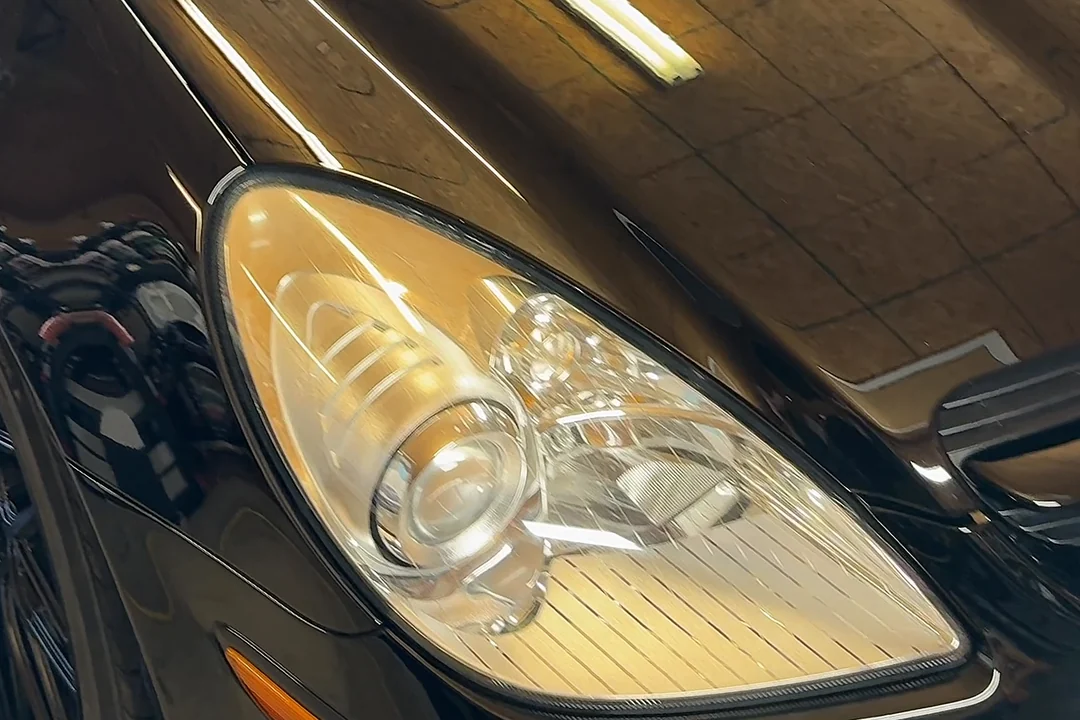
Run your fingers over the lens. If it feels rough and looks yellow or cloudy even after a wash, the fog is on the outside, and restoration fixes it. If you see droplets or a misty film behind the plastic, moisture got into the housing, and that’s a seal or housing problem that a restoration can’t reach.
Outside fog is by far the most common kind. Most headlight lenses are plastic with a thin protective coating, and sunlight wears that coating down over time. Consumer Reports’ chief mechanic says the coating deteriorates as headlights age, “particularly in areas where cars get a lot of sun.” Our post on why headlights turn yellow covers the causes in more detail.
Inside fog is different. A little condensation can come and go with the weather, but standing water or fog that never clears means the housing needs a repair shop or a replacement. We work on the outside of the lens only, so we’ll tell you honestly if your headlight needs more than a restoration.
Do Toothpaste, WD-40 and Other Home Remedies Work?
Mostly not for long. Toothpaste is mildly abrasive, so it can brighten a lightly hazed lens a little, but the haze returns because no new protection goes on. WD-40 is a hard no, since WD-40 itself lists headlight lenses among the surfaces to avoid. Soap cleans road film, not oxidation.
Here’s how the common home fixes stack up:
| Home remedy | What it does | Our take |
|---|---|---|
| Toothpaste | A mild abrasive that can improve a lightly hazed lens | Short-lived; Consumer Reports says a heavily weathered lens needs a heavy-duty product |
| WD-40 | Not made for this | Don’t use it; WD-40 lists headlight lenses under surfaces to avoid |
| Dish soap or car soap | Removes dirt and road film | Cleans the lens but doesn’t touch oxidation |
| Bug spray, soda, baking soda, peroxide | No reputable test we could find | We don’t recommend putting household chemicals on a plastic lens |
| DIY restoration kit | Sands off the damaged layer and adds a protective coat | Works, but the haze typically returns after about a year |
The toothpaste idea comes up a lot. When a reader sent the tip to Consumer Reports, its experts answered that they hadn’t tested it, but that some toothpastes are mildly abrasive and “could improve light transmission on uncoated lenses with limited oxidation.” A badly weathered lens needs more than that.
WD-40 is the one to avoid entirely. Its own surface guide lists headlight lenses among the plastics to avoid.
Do DIY Headlight Restoration Kits Work?
Yes, for a while. Consumer Reports found that headlight restoration kits, which cost about $10 to $25, work and improve night visibility, but the hazing typically becomes noticeable again after about a year. They take some elbow grease, and some need an electric drill for buffing.
A kit does the right kind of work. It sands off the damaged layer and puts a thin protective coat back on. The catch is that a thin coat applied by hand at home doesn’t hold up as long as a properly applied clear coat. Our post on why restored headlights turn yellow again explains what makes the difference and how to keep lenses clear longer.
If you enjoy a weekend project and don’t mind doing it again next year, a kit is a reasonable choice. If you’d rather have it done once and done right, that’s what our restoration is for.
What Does Professional Headlight Restoration Include?
At Level Up Detailing, headlight restoration is $199 for two headlights. We wet sand the oxidized layer off each lens, polish the plastic back to clear, then apply a new clear coat so the lens has real protection again. That clear coat is what keeps the results looking good for years instead of months.
All of the work is done inside our shop at 275 Crystal Ridge Dr in Lexington. When you call or text, tell us what you’re seeing. If the fog is on the inside or a lens is cracked, we’ll let you know before you make the trip.
Want to keep the lenses clear after that? Our Wash & Coat is a ceramic coating too, lasting up to 3 years, just without a warranty or paint correction, and it covers the paint, factory wheel faces, headlights and tail lights. Every Owner’s Pride exterior coating package also coats the head and tail lights, along with the body, trim and wheel faces.
Can Foggy Headlights Fail NC Inspection?
They can. North Carolina’s safety inspection rules say a headlight is not approved if any lens is “cracked, broken, discolored, missing” or out of position. Light condensation on its own isn’t a reason to fail, but standing water inside a lens is.
The rule doesn’t put a number on how discolored is too discolored, so the inspector makes the call. If your lenses have turned yellow or cloudy, it makes sense to have them restored before inspection time rather than after.
Foggy Headlights and Dark Commutes in Mocksville
Mocksville drivers feel cloudy headlights most in late fall and winter. In mid-November the sun sets around 5:15 PM in Mocksville, and by December 21 it sets at 5:12 PM (U.S. Naval Observatory), so a lot of drives home on US-64 and US-601 happen after dark.
The summers there are hard on lenses, too. NOAA’s Mocksville station averages about 41 days a year at 90°F or hotter (1991–2020 normals), and that sun is exactly what breaks down the coating on a headlight. Our shop is about 21 miles, roughly 35 minutes, from Mocksville.
You’ll find more on our car detailing for Mocksville page, and our Wash & Coat for Mocksville page explains the coating that protects your lenses after they’re clear.
Why Drivers Choose Level Up Detailing
- Done right the first time: every headlight restoration gets a wet sand, a polish and a new clear coat.
- Posted prices: $199 for two headlights, listed in our online shop.
- Indoor work: every car is done inside our shop at 275 Crystal Ridge Dr, Lexington.
- Authorized Owner’s Pride installer.
- Owner-run: I’m Mike Holland, and when I’m not at the shop, I fly as an emergency rescue helicopter pilot. Clear lights at night matter to me in both jobs.
Areas We Serve
We work with drivers from Lexington, Winston-Salem, Clemmons, Lewisville, Kernersville, High Point, Thomasville, Greensboro, Summerfield, Oak Ridge and Salisbury.
Frequently Asked Questions
How do you clean foggy headlights?
Wash the lens first. If it still looks cloudy or yellow, the haze is the lens’s outer protective layer breaking down, and cleaning won’t remove it. The lasting fix is to sand off the damaged layer, polish the lens and seal it with a new clear coat.
Does toothpaste work on foggy headlights?
It can help a little on a lightly hazed lens because some toothpastes are mildly abrasive. Consumer Reports hasn’t tested it and says a heavily weathered lens needs a heavy-duty product, and any improvement fades because no new protection goes on.
Can I use WD-40 on headlights?
No. WD-40 lists headlight lenses among the plastics to avoid with its Multi-Use Product.
Do headlight restoration kits work?
Yes. Consumer Reports says kits costing about $10 to $25 work and improve night visibility, but the haze typically comes back and becomes noticeable after about a year.
Why is my headlight foggy on the inside?
Fog or droplets inside mean moisture got into the housing. Restoration only works on the outside of the lens, so a seal, vent or housing problem needs a repair shop or a replacement.
How much does headlight restoration cost at Level Up Detailing?
It’s $199 for two headlights. We wet sand the oxidation off, polish the lenses and re-clear-coat them at our Lexington shop, about 21 miles from Mocksville.
Final Thoughts on How to Clean Foggy Headlights
Home remedies can buy you a few weeks, and a kit can buy you about a year, but foggy headlights come back until the damaged layer is removed and real protection goes back on. A professional restoration does both, and for $199 you get clear lenses that stay that way for years. With the evenings this dark, that’s money well spent.
Ready to see clearly again? Call or text us at (336) 780-7868, or send us your info through our contact page, to set up an appointment. You’ll find us at 275 Crystal Ridge Dr, Lexington, NC 27295, open Monday through Saturday, 9 AM to 6 PM.